What Is AI, Really? A Plain-English Explanation for Leaders
MASE Learn | Fundamentals Track | Article F-01 Estimated read time: 14 minutesWhat AI Actually Is: Pattern Recognition at Scale
Strip away the mystique, and artificial intelligence is fundamentally about one thing: finding patterns in data and using those patterns to make predictions or decisions.
That's it. That's the core of it.
When your email sorts spam from legitimate messages, it's recognizing patterns in word usage, sender behavior, and formatting that distinguish unwanted mail from important correspondence. When Netflix recommends a show, it's matching patterns in your viewing history against millions of other users to predict what you'll enjoy. When a manufacturing system flags a potentially defective part, it's identifying patterns in sensor data that correlate with past failures.
What makes this "artificial intelligence" rather than simple programming is how these patterns are discovered.
Traditional software works like a recipe: a programmer writes explicit rules, and the computer follows them. "If the sender is not in the contact list AND the email contains the word 'urgent' AND there's a suspicious attachment, mark as spam." Every rule must be anticipated, written, and maintained by humans.
AI systems work differently. Instead of being programmed with rules, they're trained on examples. Show the system a million emails—some labeled spam, some labeled legitimate—and it will discover its own rules. It might find patterns no human would think to look for: subtle timing signatures, character encoding anomalies, or correlations between sender domains and message structure.
The fundamental shift: Traditional software encodes human knowledge explicitly. AI systems derive knowledge from data implicitly.
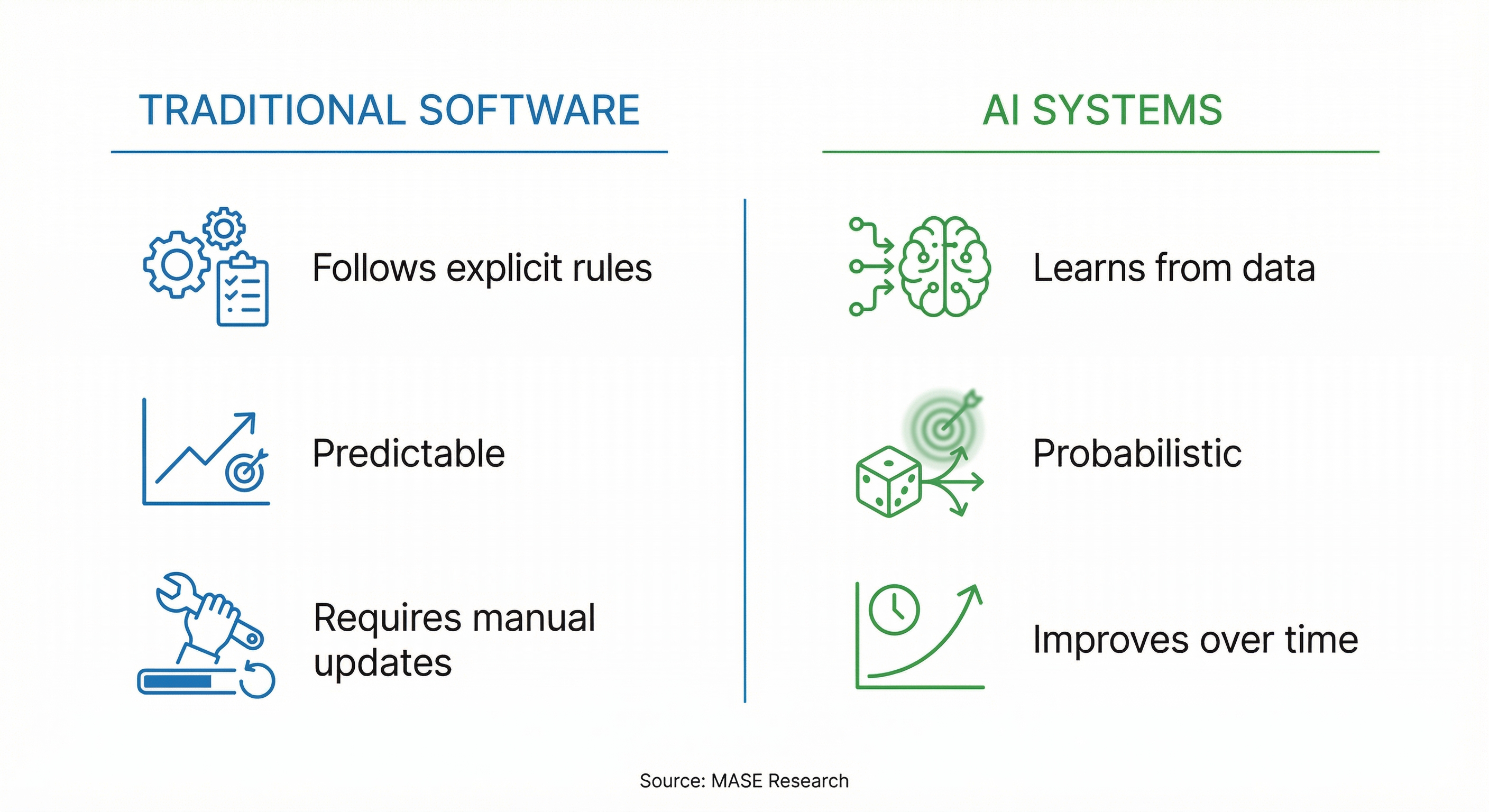
This distinction has profound implications. It means AI can solve problems where humans can't articulate the rules—like recognizing faces, understanding natural language, or detecting fraud in complex financial transactions. But it also means AI systems can develop blind spots, biases, and failure modes that no one anticipated, because no one explicitly designed them.
The Spectrum: From Rule-Based Systems to Learning Systems
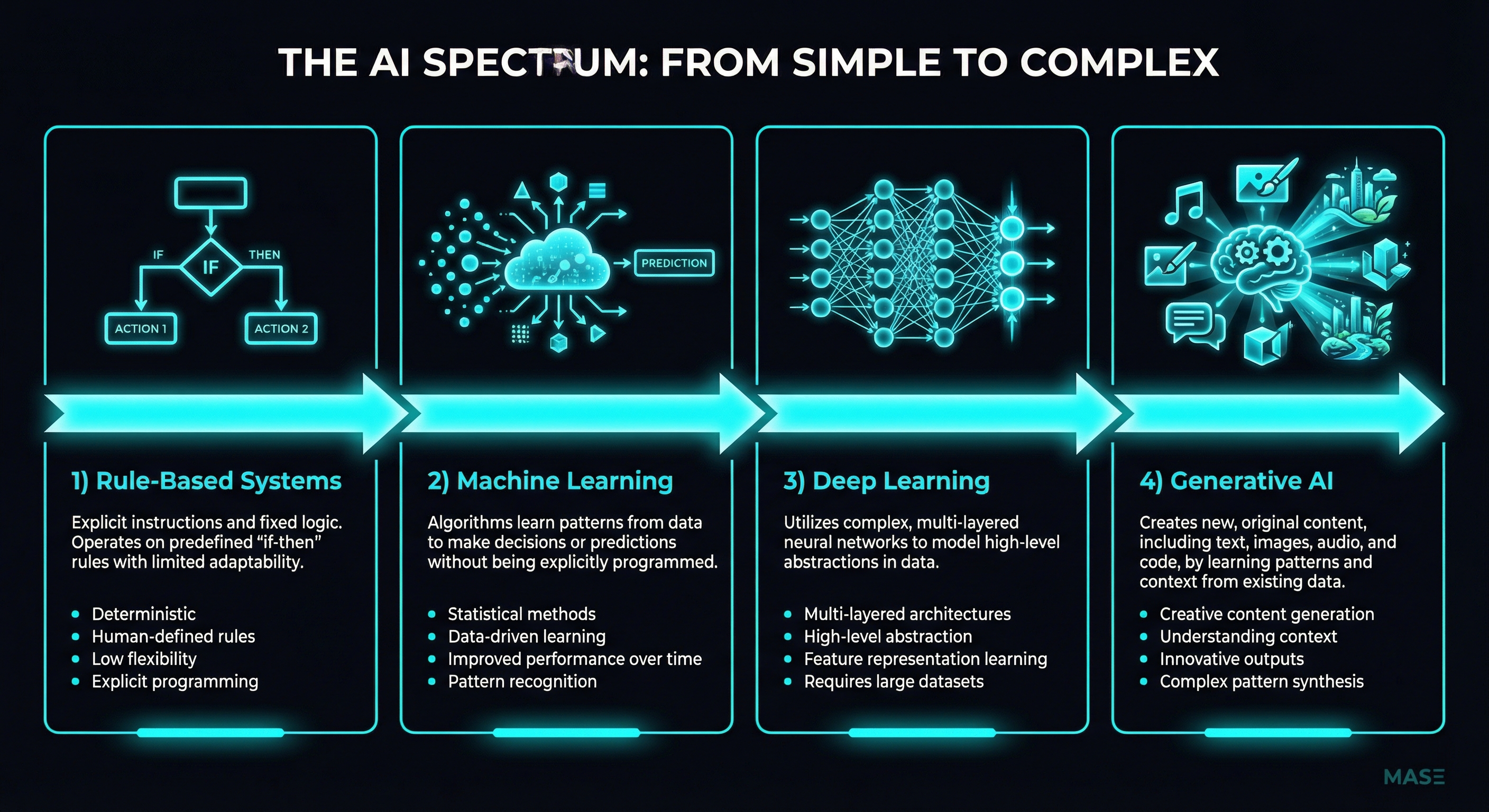
Not everything called "AI" works the same way. The term covers a broad spectrum of technologies, and understanding where a system falls on this spectrum tells you a lot about what it can and can't do.
Rule-Based Systems (Expert Systems)
On one end, you have systems that look like AI but are really just elaborate decision trees. These "expert systems" were the dominant approach in the 1980s. Engineers would interview human experts, document their decision-making rules, and encode those rules in software.
A classic example: MYCIN, developed at Stanford in the 1970s, could diagnose bacterial infections and recommend antibiotics. It worked by following hundreds of if-then rules extracted from infectious disease specialists.
These systems can be remarkably effective within narrow domains. But they're fundamentally limited: they can only know what they're explicitly told, they can't improve from experience, and they become unwieldy as complexity grows.
Machine Learning
The middle of the spectrum—and the category that dominates today's AI landscape—is machine learning. These systems learn patterns from data rather than being explicitly programmed.
The process typically works like this:
The key insight is that the model is derived from data, not written by hand. This is what allows machine learning to tackle problems where explicit rules are impractical—like understanding the sentiment of a customer review or identifying a specific person in a photograph.
Deep Learning and Neural Networks
At the far end of the spectrum are deep learning systems—the technology behind the most dramatic AI advances of the past decade. These use artificial neural networks, computing structures loosely inspired by the brain, with many layers of interconnected processing nodes.
Deep learning excels at unstructured data: images, audio, video, natural language. The systems that power Google Translate, Tesla's autopilot, and ChatGPT all rely on deep learning architectures.
What makes these systems powerful is also what makes them opaque. A deep learning model might have billions of parameters—mathematical weights adjusted during training—and even the engineers who build them often can't explain precisely why the model makes specific decisions. This is the "black box" problem you've likely heard about.
What Makes Something "Intelligent" in the AI Sense?
The word "intelligence" trips people up. It invites comparison to human cognition, which creates confusion about what AI systems can actually do.
In the AI field, "intelligence" has a narrower, more technical meaning. An AI system is considered intelligent to the degree that it can:
A spam filter is intelligent in this sense: it perceives incoming emails, reasons about their characteristics, decides whether they're spam, and learns from your corrections when it gets it wrong.
But note what's missing from this definition: understanding, consciousness, general purpose reasoning, common sense, moral judgment. Today's AI systems—including the most advanced ones—don't have any of these things.
Critical distinction: AI systems can exhibit intelligent behavior in specific domains without possessing general intelligence. They're tools, not minds.
This is important because it shapes what you should expect. An AI system trained to review contracts will not spontaneously understand your broader business strategy. A chatbot that handles customer service won't actually care about your customers. The intelligence is narrow, task-specific, and fundamentally mechanical—however impressive the outputs might appear.
AI vs. Automation vs. Simple Software: Clear Distinctions
The terms "AI," "automation," and "software" are often used interchangeably, but they describe genuinely different things. Understanding these distinctions will help you cut through vendor hype and assess what technologies actually do.
Simple Software
Traditional software executes predetermined instructions. A calculator, a word processor, a basic inventory system—these follow explicit rules written by programmers. Given the same input, they produce the same output, every time. There's no learning, no adaptation, no prediction.
Automation
Automation refers to using technology to perform tasks without human intervention. This can involve simple software (a scheduled report), mechanical systems (an assembly line robot), or AI (an automated fraud detection system).
The key distinction: automation is about replacing human labor in a process. It can use AI, but doesn't have to. An automated email response that sends the same message to everyone isn't using AI. An automated email response that analyzes the incoming message and generates a contextually appropriate reply probably is.
Artificial Intelligence
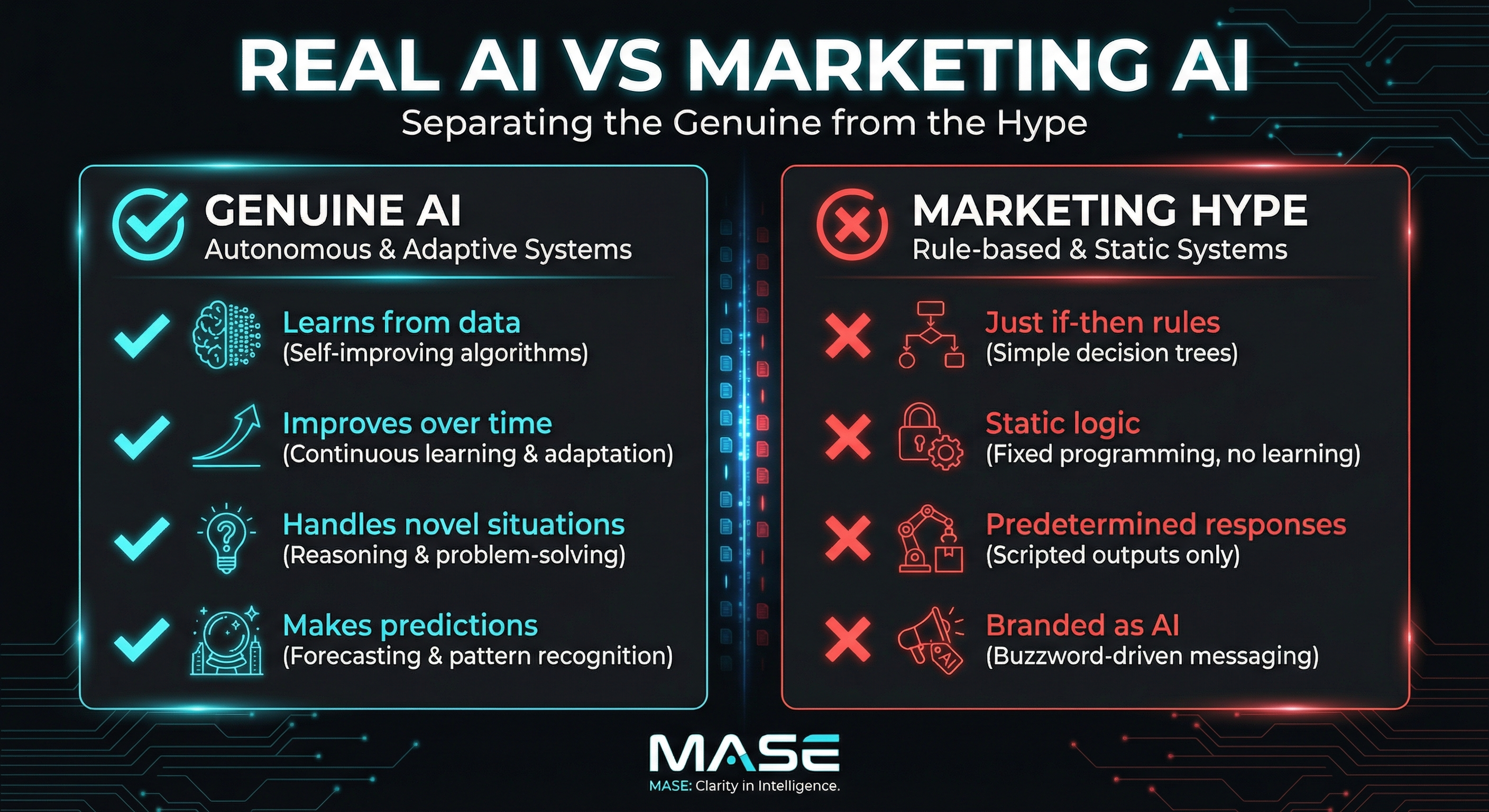
AI specifically refers to systems that exhibit some form of machine-based learning, reasoning, or decision-making. The defining characteristic is adaptability: AI systems can handle novel inputs they weren't explicitly programmed for, because they've learned patterns rather than memorized rules.
A practical test: If the system can improve its performance based on new data—without a programmer rewriting code—it's probably AI. If it can handle situations its creators didn't specifically anticipate—because it learned patterns rather than rules—it's probably AI.Why This Matters for Vendor Conversations
Many vendors slap "AI-powered" on products that are really just traditional software with a modern interface. Questions to ask:
- "What data does this system learn from?"
- "How does performance improve over time?"
- "What happens when it encounters situations outside its training?"
If the answers are vague, you may be looking at marketing rather than genuine AI capability.
Real-World Examples: What's Actually AI vs. Marketing Fluff
Let's look at specific examples to make these distinctions concrete.
Genuinely AI-Powered
JPMorgan's Contract Intelligence (COiN): This system reviews commercial loan agreements, extracting key data points and identifying potential issues. According to JPMorgan, it performs in seconds work that previously took lawyers 360,000 hours annually. It's AI because it learned to understand contract language from thousands of examples, can handle novel phrasings it hasn't seen before, and improves as it's exposed to more documents. UPS ORION (On-Road Integrated Optimization and Navigation): This routing system analyzes 250 million address points and calculates optimal delivery routes across 55,000 vehicles. It's AI because it continuously learns from driver behavior, traffic patterns, and delivery outcomes to improve recommendations over time. Moderna's mRNA Platform: During COVID-19 vaccine development, Moderna used machine learning to optimize mRNA sequences, predict stability, and accelerate clinical development. This is AI because the system learned patterns in molecular behavior from experimental data, enabling predictions for novel sequences.Probably Not AI (Despite Marketing Claims)
"AI-Powered" Calendar Apps: Many scheduling tools claim AI but really just follow rules about availability and preferences. If it can't learn your actual behavior and adapt—just match calendars based on stated rules—it's traditional software. Basic Chatbots: A chatbot that matches keywords to pre-written responses isn't AI. It's a decision tree with a conversational interface. True AI chatbots (like those powered by large language models) generate novel responses based on learned language patterns. "Smart" Home Devices: A thermostat that follows a schedule isn't AI. A thermostat that learns your preferences from behavior patterns and adapts to optimize comfort and energy use (like Nest) is.The Gray Zone
Some products occupy a middle ground—using machine learning for specific features while remaining largely rule-based. Google Maps uses AI for traffic prediction and estimated arrival times but rule-based algorithms for basic routing. Many "AI-powered" products work this way, with genuine machine learning in specific components surrounded by traditional programming.
The "It's Just Statistics" Perspective (And Why That's Incomplete)
You'll encounter people—often technically sophisticated ones—who dismiss AI with "it's just statistics" or "it's just pattern matching." This perspective isn't wrong, but it's incomplete.
Yes, most modern AI is fundamentally statistical. Machine learning algorithms are optimization techniques finding mathematical functions that map inputs to outputs. The models are probability distributions learned from data. At its mathematical foundation, AI is applied statistics.
But this framing misses something important: scale and emergence create qualitative differences.
A single neuron is just an electrochemical switch. But 86 billion neurons, properly connected, produce human consciousness. A single statistical relationship is trivial. But billions of learned parameters, properly organized, produce systems that can write poetry, generate photorealistic images, or hold substantive conversations.
The emergence principle: Complex systems can exhibit properties that aren't present in their components. AI systems, built from simple statistical operations, can exhibit behaviors that feel genuinely intelligent.
Consider large language models like GPT-4. At one level, they're "just" predicting the next word in a sequence based on statistical patterns learned from text. But somehow, this simple objective—trained on enough data, with enough parameters—produces systems that can reason about novel problems, explain complex concepts, and generate creative content.
We don't fully understand how this works. That's actually part of the point: the systems have become complex enough to exhibit emergent properties that surprise even their creators.
For business leaders, the practical implication is this: don't let "it's just statistics" lull you into underestimating what these systems can do. The best mental model isn't to compare AI to a regression analysis. It's to treat it as a new category of tool—one that can exhibit intelligent behavior within specific domains, even if the underlying mechanics are mathematical.
What This Means for Your Business
Understanding what AI actually is—and isn't—has concrete implications for how you should approach it.
For Strategy
AI is a capability amplifier, not a magic solution. It can dramatically accelerate pattern-dependent tasks: classification, prediction, optimization, generation. But it requires clear problems, quality data, and integration into actual workflows. Organizations that treat AI as a technology to be "deployed" rather than a capability to be developed usually fail. The competitive dynamic is shifting. According to Stanford's 2024 AI Index Report, the cost of training cutting-edge AI systems has dropped dramatically, but the cost of acquiring and preparing high-quality training data remains high. Your competitive advantage increasingly depends on proprietary data and the organizational capability to act on AI-derived insights—not on the algorithms themselves.For Investment Decisions
Ask what problem is being solved. Before any AI investment, be clear about the specific business problem, the data available to train a solution, and how you'll measure success. "We need AI" is not a strategy. "We need to reduce customer churn by identifying at-risk accounts earlier" is a problem that AI might help solve. Beware the pilot trap. McKinsey reports that while most organizations have run AI pilots, only 8% of companies have successfully scaled AI capabilities across the enterprise. Success requires not just technical proof-of-concept but integration into existing systems, change management, and ongoing operational support.For Risk Management
AI systems can fail in unexpected ways. Because they learn patterns rather than follow explicit rules, they can develop biases from training data, fail in edge cases, or degrade as conditions change. Build monitoring, human oversight, and rollback capabilities into any AI deployment. The black box problem is real. Many AI systems—especially deep learning models—can't explain their decisions. In regulated industries or high-stakes decisions, this opacity creates legal, ethical, and operational risks. Understand when explainability is required and choose technologies accordingly.For Talent and Organization
AI changes jobs more than it eliminates them. The World Economic Forum projects that by 2025, AI will displace 85 million jobs but create 97 million new ones. The net effect isn't mass unemployment but mass transformation—requiring new skills, roles, and organizational designs. Technical capability is necessary but not sufficient. Many AI failures aren't technical—they're organizational. Success requires data science talent, yes, but also leaders who understand the technology well enough to ask good questions, managers who can redesign workflows around AI capabilities, and employees who can work effectively alongside automated systems.Key Takeaways
This article is part of the MASE Learn Fundamentals Track. Next in the series: "How Machines Learn: A Visual Guide to Training AI Systems" (F-02)
Sources and Further Reading:
- McKinsey & Company. "The State of AI in 2024." McKinsey Global Survey, May 2024.
- Stanford University Human-Centered Artificial Intelligence (HAI). "AI Index Report 2024."
- World Economic Forum. "The Future of Jobs Report 2023."
- Russell, Stuart and Peter Norvig. Artificial Intelligence: A Modern Approach, 4th Edition. Pearson, 2020.
- Marcus, Gary and Ernest Davis. Rebooting AI: Building Artificial Intelligence We Can Trust. Pantheon, 2019.